A Disney Resort suffered immense problems on the morning of January 16, 2026, leading to canceled vacations, ticket refunds and so much more.
What happened?

The magic of a Disney morning is supposed to begin long before the gates open.
For many guests, it starts on a train platform—coffee in hand, excitement building, ears packed away in a backpack, and a carefully planned itinerary waiting to be executed minute by minute. At Tokyo Disney Resort, where efficiency and punctuality are practically part of the brand promise, those early-morning moments are usually seamless. Trains arrive on time. Lines move quickly. The experience feels choreographed.
That expectation is part of why Tokyo Disney Resort holds such a revered place in the global Disney community. Often praised as the most operationally flawless Disney destination in the world, it has become a benchmark for what theme park logistics should look like.
But on the morning of January 16, that illusion cracked.
A Morning Built on Precision Suddenly Felt Unstable
Tokyo is a city that runs on rhythm. Millions of commuters rely on rail lines that operate with near-military precision, and theme park guests benefit from that same infrastructure. For travelers heading to Tokyo Disneyland or Tokyo DisneySea, the journey is usually as reliable as the attractions themselves.
That’s what made this particular morning so unsettling.
Before sunrise, crowds began forming earlier than usual. Platforms filled faster. Guests heading for early park admission found themselves shoulder-to-shoulder—not in queues designed for excitement, but in stations designed for flow. Something was clearly off, yet no official announcements immediately explained why.
Inside the Disney fandom, unease spread quickly. When the systems that support the magic begin to falter, even briefly, it creates a ripple effect—especially in a destination where expectations are sky-high.

Social Media Filled the Information Gap Almost Instantly
As is often the case now, social media became the first source of real-time reporting.
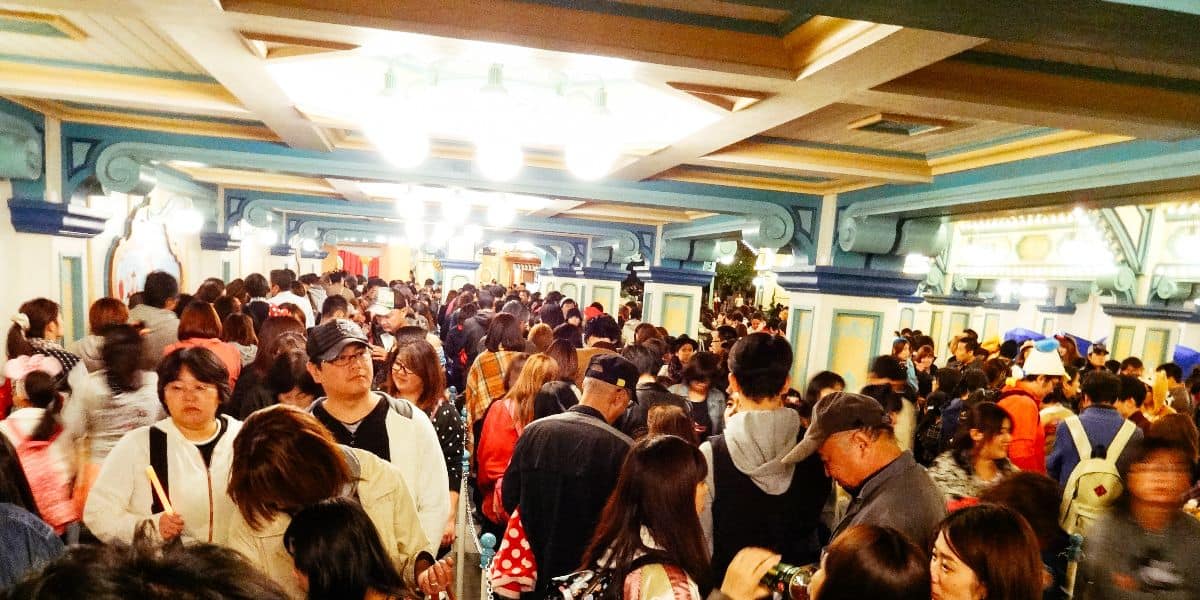
Photos and videos began circulating on X (formerly Twitter) and Reddit showing unusually massive crowds at stations servicing Tokyo Disney Resort. Some clips showed guests packed tightly near entry points, while others captured the strain of morning commuters attempting to reroute themselves in real time.
Commuter Hell in Tokyo this morning: a power outage caused several major train lines, including the Yamanote and Keihin Tohoku lines, to suspend service. This is a video from inside Ueno Station. – @mrjeffu on X
https://twitter.com/mrjeffu/status/2012004779980136538?s=20
Fans and travelers alike expressed confusion—and concern. Several posts questioned whether early park admission would even be possible for some guests, while others speculated about safety and crowd control as congestion intensified.
今日のランドは駅側も駐車場側もハピエンも、パルパル初日より数m短いくらいです。 ほぼ混雑は同じだと思って来た方が良いと思います。 写真左が今日の7:03駅側 右が初日7:03駅側
Today, the lines at the park—both on the station side and the parking lot side, as well as Happy Entry—are only a few meters shorter than on the first day of PalPal.
It’s probably best to come expecting roughly the same level of crowding.
The photo on the left shows today at 7:03 on the station side.
The photo on the right shows the first day at 7:03 on the station side. – @joejoemagic on X
https://twitter.com/joejoemagic/status/2011934882415456429?s=20
For a resort known globally for crowd management excellence, the visuals felt jarring.
Tokyo Disney Resort Has Always Relied on the City Around It
Unlike Walt Disney World or Disneyland Resort, Tokyo Disney Resort is deeply intertwined with its surrounding urban infrastructure. Guests rely heavily on Tokyo’s rail system to access the parks, particularly lines operated by East Japan Railway Company (JR East).
That system doesn’t just move people—it enables the Disney experience.
When transportation runs smoothly, the parks function like clockwork. When it doesn’t, even briefly, the effects are immediate. That reality became impossible to ignore as the morning wore on and crowds continued to swell beyond normal levels.
What Actually Happened—and Why It Mattered So Much
Around the 500-word mark, the full picture came into focus.
A major power outage struck Tokyo during the early morning hours, disrupting the city’s rail network at one of the worst possible times. According to reports from Reuters and other major outlets, a railway power failure halted service on JR East’s Yamanote and Keihin-Tohoku lines, two of the most critical arteries in the region.
The outage impacted approximately 673,000 passengers, with service disruptions lasting up to nine hours. The cause was traced to a failure to restore power following overnight maintenance work at Tamachi Station, where smoke was reportedly seen coming from track-side equipment.
In some cases, passengers were forced to evacuate stranded trains by walking along the tracks, assisted by firefighters and railway staff. Images showed stations overwhelmed as commuters—and Disney-bound guests—scrambled for alternatives.
With both lines servicing major hubs like Shinjuku, Tokyo Station, and Yokohama, the disruption rippled across the entire city—including Tokyo Disney Resort.
What This Means for Guests Visiting Tokyo Disney Today
While Tokyo is known for its efficiency—even during unexpected disruptions—this incident serves as a reminder that no system is immune to failure.
Guests planning to visit Tokyo Disneyland or Tokyo DisneySea today should expect transportation delays, particularly if relying on train service. Early entry plans may be affected, arrival times could vary significantly, and patience will be essential.
Importantly, fans on social media have emphasized remaining respectful toward cast members, railway staff, and emergency responders working under extraordinary pressure.
An Uncomfortable Reminder That Even Magic Depends on Power
Tokyo Disney Resort remains one of the most beloved theme park destinations in the world—but this morning underscored a truth that’s easy to forget: even the most magical places depend on systems beyond their control.
For travelers, the takeaway is simple but important—plan ahead, allow extra time, and stay informed.
And for fans watching from afar, it was a rare glimpse at how fragile even the most finely tuned experiences can be.
Have you ever experienced a transportation disruption on a Disney vacation? Do moments like this change how you plan your trips? Let us know what you think.