For decades, a trip to Walt Disney World Resort has represented something bigger than a vacation. For many families, it is tradition. A milestone. A place where generations return to relive memories that somehow feel frozen in time.
But over the last several years, fans have noticed something changing.
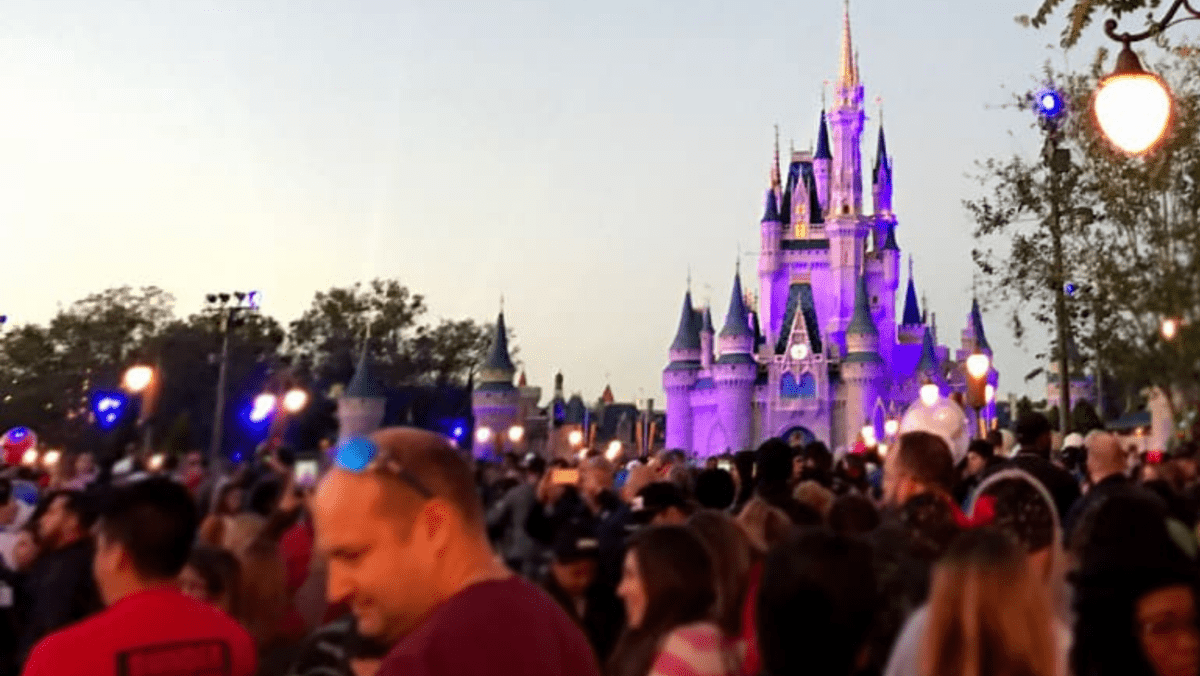
The atmosphere inside Disney’s parks has become increasingly intense. Walkways are tighter. Mobile order windows disappear within minutes. Lightning Lane return times stretch into the evening. Guests are already reacting to rising prices while simultaneously questioning whether the experience can continue operating at its current pace.
And now, Disney itself is acknowledging the pressure.

Disney Finally Confirmed What Guests Have Been Feeling for Years
During recent remarks discussing the future of the company’s theme park business, Disney CFO Hugh Johnston admitted something longtime parkgoers have suspected for a while: Walt Disney World is effectively at capacity during many peak periods.
That statement matters more than it may initially sound.
For years, Disney has continued introducing new ticket systems, reservation programs, premium add-ons, and crowd-management tools designed to maximize efficiency. But Johnston made it clear that meaningful attendance growth moving forward cannot come from simply squeezing more people into existing parks.
Instead, Disney believes the only true solution is expansion.
Fans are noticing how significant that shift feels. Rather than increasing operational density alone, Disney appears ready to fundamentally reshape the footprint of its Florida resort over the next decade.

Why Disney’s Price Hikes Suddenly Make More Sense
Disney’s recent price increases have frustrated many visitors.
From higher ticket costs and hotel rates to Lightning Lane purchases and food price jumps, guests have repeatedly questioned why vacations are becoming dramatically more expensive. But Johnston’s comments may provide clearer context behind Disney’s broader strategy.
Expansion on the scale Disney is now planning is extraordinarily expensive.
The company previously announced a massive $60 billion investment into its parks, experiences, and cruise businesses over the next ten years, with a major portion expected to impact Walt Disney World directly.
That money is already beginning to materialize.
Guests are already reacting to major projects tied to Magic Kingdom Park, Disney's Hollywood Studios, and Disney's Animal Kingdom Theme Park.
At Magic Kingdom, Disney has teased one of the largest expansions in the park’s history beyond Big Thunder Mountain Railroad. At Animal Kingdom, new plans connected to Tropical Americas are reshaping DinoLand U.S.A. Meanwhile, Hollywood Studios continues evolving into one of Disney’s most aggressively expanding parks following the additions of Star Wars: Galaxy’s Edge and Toy Story Land.
These projects are not simply designed to add attractions. They are designed to redistribute human traffic.

Disney’s Expansion Strategy Could Change How Crowds Move Forever
One of the biggest operational challenges Disney faces is concentration.
Walt Disney World is at capacity. CFO Hugh Johnston says meaningful attendance growth only comes through expansion – not cramming more guests in. A $60 billion investment cycle is already underway, with new lands coming to Magic Kingdom, Hollywood Studios, and Animal Kingdom. – @wdwmagic on X
Walt Disney World is at capacity. CFO Hugh Johnston says meaningful attendance growth only comes through expansion – not cramming more guests in. A $60 billion investment cycle is already underway, with new lands coming to Magic Kingdom, Hollywood Studios, and Animal Kingdom. pic.twitter.com/ErlVSMWzHg
— WDWMAGIC.COM (@wdwmagic) May 14, 2026
When guests overwhelmingly gather in a handful of popular areas, crowd levels intensify rapidly. That creates longer waits, guest frustration, and operational bottlenecks that ripple throughout the day.
New lands help solve that problem in multiple ways.
First, they create entirely new destinations that absorb crowds away from older attractions. Second, they encourage guests to spread themselves across larger portions of the parks. Third, they extend overall guest stay time throughout the resort instead of concentrating activity into narrow windows.
Fans are noticing that Disney’s newest expansions often emphasize immersion and scale over simple ride count.
Galaxy’s Edge, Pandora – The World of Avatar, and even EPCOT’s ongoing transformation all prioritize wider pathways, layered environments, dining, entertainment, and exploration space. That is not accidental.
Disney is building parks that can physically hold more people without necessarily feeling more crowded.

Guests May Be Entering a Completely Different Disney Era
The conversation around Disney parks is increasingly shifting from attraction-based growth to infrastructure-based growth.
That distinction matters.
In previous decades, Disney could boost attendance with a few headline attractions. Today, the company appears to understand that the guest experience itself is becoming the product under pressure.
Longtime visitors often compare modern crowd levels to pre-2020 vacations and immediately notice the difference. Even during traditionally slower seasons, parks can feel packed.
A surprising change is now emerging from Disney’s response: the company is no longer pretending operational tweaks alone can fix the issue.
Instead, executives are openly discussing physical limitations.
That honesty may signal one of the most important transitions in modern Disney history.
Disney’s Future Could Depend on How Fast These Expansions Arrive
Disney’s challenge now becomes timing.
Guests are already paying premium prices today while waiting for many of these promised additions to arrive years down the road. That creates pressure on Disney to deliver expansions quickly enough to justify rising vacation costs and guest expectations.
At the same time, these projects could dramatically reshape how future visitors experience Walt Disney World altogether.
If Disney succeeds, future crowds may feel more balanced despite attendance growth. Parks could become larger, more immersive, and operationally smoother than they are today.
But if attendance continues climbing faster than expansion arrives, crowd frustrations may only intensify.
Either way, Disney has now made one thing unmistakably clear: the future of Walt Disney World will not be built by packing more guests into the same spaces. It will be built by creating entirely new worlds for them to explore.