Seven hundred pages of court depositions do not usually make for compelling reading. This particular set of 700 pages is an exception.

Florida Politics reporter Gabrielle Russon spent months obtaining and working through court records from the Disney-DeSantis legal dispute, and what she found rewrites the conventional understanding of what that fight was actually about. The public version of the story was a governor picking a fight with a corporation over a political statement. The version that emerges from the depositions is messier, higher-stakes, and considerably more consequential for the physical future of Walt Disney World.
Billion-dollar expansion plans were quietly shelved. A law firm with ties to the governor's office drafted documents it did not want its own name attached to. A board member believed his job was to make the governing district cease to exist. And a major road project near two of Walt Disney World's most iconic resort hotels remains unfinished as of this spring.
The settlement between Disney and the Central Florida Tourism Oversight District has resolved the immediate legal conflict, and Disney says development is now “moving full speed ahead with the support of” CFTOD, with “more projects underway at Walt Disney World than at any other point in our history.” But the depositions Russon obtained capture a period when none of that was guaranteed, and the decisions made during that window have left marks that are still visible on the property today.
The Expansion That Got Put on Hold

The headline finding in Russon's reporting is that Disney's leadership, up to and including Walt Disney World Resort President Jeff Vahle, reached what the depositions describe as a “general agreement” to pause Magic Kingdom's largest planned expansion at the height of the feud. The reason was not creative hesitation or budget concerns. It was political uncertainty about whether the new DeSantis-controlled board would approve the wetland mitigation credits the project required to move forward.
Master Planning Executive Todd Rimmer spelled it out in his deposition testimony: “When we're looking at billions of dollars of investment, we want to be certain that we can proceed.”
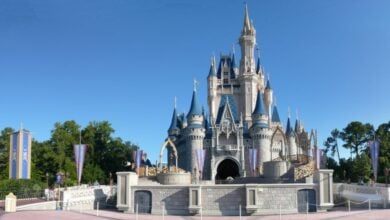
The expansion being discussed includes Villains Land and new attractions that Disney did not publicly announce until August 2024, which was months after Rimmer gave that testimony. Guests visiting Walt Disney World right now can see what this looks like from the other side: construction is active at Magic Kingdom, aerial photos from February 2026 show significant work underway at what is becoming Piston Peak, and the broader expansion pipeline is moving. What the depositions reveal is that it almost did not. A governance dispute nearly froze billions of dollars of investment at one of the most beloved theme park destinations in the world.
A Law Firm That Wanted Its Name Off the Documents

The legal maneuvering Disney employed before the new board took over is one of the stranger threads in Russon's reporting. According to the depositions, Disney brought in Holtzman Vogel, a firm with significant ties to the DeSantis administration, to help draft a development agreement that would lock in Disney's expansion rights before DeSantis' appointees assumed control of the board.
The firm did not want anyone to know it was involved. Chief Counsel John McGowan testified that Holtzman Vogel feared being seen as working against the governor and potentially losing the more than $16 million in state legal work it had received since 2021. McGowan had his own name stripped from the agreement's documents as well, explaining in testimony that he was trying to prevent what he called “a false narrative” that the agreement was “something shoved down the district's throat.”
The outgoing Reedy Creek board approved the development agreement in a matter of weeks, before DeSantis' new appointees took over. The details presented to that board were deliberately kept vague. McGowan wrote the talking points for Reedy Creek District Administrator John Classe to use and chose his words accordingly. “We think less is more in this case,” McGowan wrote, according to court records Russon obtained.
When the incoming board discovered what had happened, the reaction was not quiet. Chair Martin Garcia called it “a caper worthy of Scrooge McDuck” in public remarks that traveled fast through the political press.
There is also the matter of whether DeSantis‘ office actually knew about the agreement before it was approved, despite the public fury that followed. McGowan testified that Ray Treadwell, the Chief Deputy General Counsel in DeSantis' Office, may have been aware of the development agreement in advance. McGowan said that information came from Disney lobbyist Adam Babington. DeSantis and Treadwell did not respond to Florida Politics' requests for comment.
The Road That Never Got Finished
Abstract legal battles tend to stay abstract. This one left something concrete behind that guests near the Grand Floridian and Polynesian Village Resort can see for themselves right now.
World Drive Phase III was a $175 million project to widen a two-lane section of road near those resorts into four lanes. The new board refused to issue the municipal bonds needed to fund the project. Construction stalled. As of April 2026 the project remains incomplete and active construction work is still visible near the Grand Floridian.
The depositions add important context about why this happened. DeSantis appointee Brian Aungst Jr. testified in a way that suggested his understanding of his mandate was to eliminate the governing district entirely, not to oversee it in a different direction. When the goal is dissolution rather than administration, infrastructure decisions that would otherwise be routine become leverage points, and a road widening project near two of the most expensive resort hotels on Disney property becomes something that does not get funded.
What Guests Are Seeing Now

The feud is functionally over. DeSantis is in his final year as governor. All of his original board appointees, including Aungst, have been replaced. Disney and CFTOD have settled their legal disputes.
What visitors to Walt Disney World encounter today is the resort that came out the other side of all of this: an active and unusually large construction pipeline, expansion plans that were paused and then restarted, and in at least one spot near the Grand Floridian, a road project that the feud interrupted and that has not yet been finished.
The depositions Russon obtained do not change what Walt Disney World is as a destination. They change the understanding of what it took to get the expansion currently underway approved and moving, and how close the timeline came to looking very different.
If Walt Disney World is on your travel calendar this year or next, it is worth knowing which projects are active and what the construction timeline looks like before you book. Some of the most significant additions to the resort in years are underway right now across multiple parks. Our planning guide has current construction information by park so you can factor the timeline into your trip decisions.