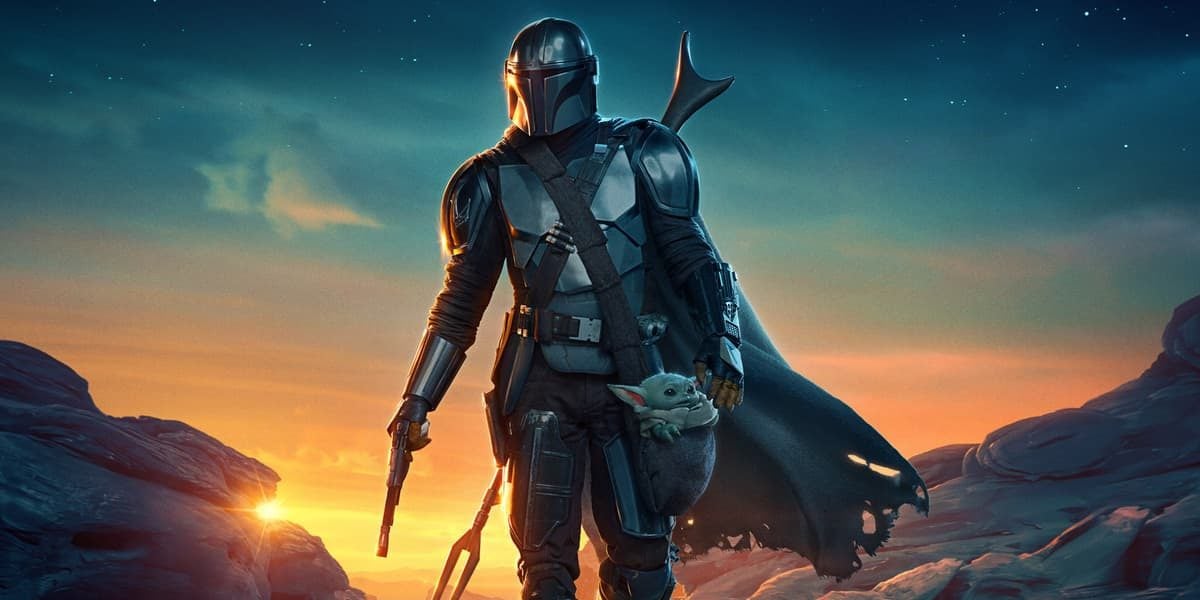
Star Wars is finally returning to theaters after a seven-year absence, and Lucasfilm is betting that one of its biggest streaming successes can carry that weight. The Mandalorian and Grogu arrives on May 22, 2026, marking the franchise’s first theatrical release since Star Wars: Episode IX—The Rise of Skywalker divided audiences in 2019.

A Streaming Hit Takes a Cinematic Leap
When The Mandalorian premiered on Disney+ in 2019, it stood apart from traditional Star Wars storytelling. Din Djarin was a bounty hunter operating on the galaxy’s edges, uninterested in grand causes or galactic politics. His neutrality, combined with a morally flexible code, gave the series a tone that felt distinct from the franchise’s theatrical legacy.
The upcoming film moves away from that foundation. Directed by Jon Favreau and produced by Favreau, Kathleen Kennedy, Dave Filoni, and Ian Bryce, The Mandalorian and Grogu transforms its central character into a far more traditional figure within the Star Wars framework.

Din Djarin Chooses a Side
The shift was set up in the Disney+ series’ third season finale, when Din rejected the bounty hunter lifestyle outright. “I don't want to go out there and just be a hired gun. I want to work for the good guys,” he said, signaling a clear change in direction.
Favreau later confirmed that this moment defines the film’s approach.
“One of the last things we say [in Season 3] is, like, ‘I don’t want to go out there and just be a hired gun. I want to work for the good guys,'” Favreau told Empire Magazine.

According to the official synopsis, Din and Grogu are now actively working for the New Republic, hunting Imperial warlords who threaten its fragile stability. The morally ambiguous freelancer introduced in Season 1 is now firmly aligned with institutional authority, a move that places the character more squarely within classic Star Wars hero territory.
Grogu’s Powers Expand
Din isn’t the only character undergoing change. A leaked synopsis suggests Grogu discovers an ancient Force-amplifying artifact during the film. The device is reportedly found inside an abandoned Imperial facility on the planet Khar'Zuun while Din and Grogu pursue Imperial remnants.
Throughout the series, Grogu’s abilities were powerful but inconsistent, often leaving him exhausted. The artifact could remove those limitations, granting him more sustained control over the Force. The timing of this development suggests a practical narrative purpose, as marketing materials hint that Din and Grogu may be separated for portions of the story.

Empowering Grogu allows him to function independently rather than remaining a constant liability. It also positions the film as a turning point, creating a clear distinction between the Grogu audiences knew on Disney+ and the version that emerges by the end of the movie.
The artifact’s presence within an Imperial facility raises larger questions about the Empire’s experiments with Force manipulation, potentially tying Grogu’s evolution to deeper Star Wars mythology.

Why a Film Instead of Season 4?
Lucasfilm’s decision to produce a theatrical film instead of a fourth season sparked immediate debate. Favreau has emphasized that the movie is not a repurposed television storyline.
“We were planning on doing a fourth season,” Favreau said. “I had actually written all of that. I still have Season 4 sitting on my desk here.”
Television allowed The Mandalorian to unfold slowly through episodic storytelling. A film requires a single, self-contained arc with compressed pacing and higher immediate stakes. Favreau has indicated the movie embraces that structure, aiming for a scale that wouldn’t fit within the series’ format.

Rotta the Hutt Changes the Dynamic
One of the film’s most unexpected additions is Jeremy Allen White as Rotta the Hutt, the adult son of Jabba. Early indications suggest Rotta spends significant screen time with Din, potentially becoming his primary companion for much of the story.
White fueled speculation when he revealed that he and Din would be “running around for a lot of the movie together.” Promotional footage supports this idea, often showing Din and Grogu in separate sequences rather than side by side.

Rotta’s inclusion opens new narrative territory. Introduced as an infant in Star Wars: The Clone Wars (2008), he now occupies a powerful position in the post-Empire criminal underworld. His role could force Din to confront uncomfortable moral compromises as part of his new alignment with the New Republic.
Grogu’s apparent separation from Din may allow both characters to evolve independently before reuniting, each shaped by experiences that fundamentally alter their roles within the story.

A Defining Moment for Modern Star Wars
The Mandalorian and Grogu is positioned as more than a continuation of a popular series. It represents Lucasfilm’s attempt to translate streaming success into theatrical relevance while redefining its characters in the process.
Din’s move from detached bounty hunter to New Republic operative, Grogu’s amplified abilities, and Rotta the Hutt’s expanded role all signal a willingness to reshape familiar elements. Whether audiences embrace those changes or prefer the series’ original identity will be revealed when Star Wars returns to theaters on May 22, 2026.

The Mandalorian and Grogu stars Pedro Pascal as Din Djarin, Sigourney Weaver as Admiral Ward, Jeremy Allen White as Rotta the Hutt, Jonny Coyne as an Imperial Warlord, Dave Filoni as Trapper Wolf, and Steven Blum as Garazeb “Zeb” Orrelios.
How do you feel about all these departures from The Mandalorian TV series? Let us know in the comments down below!