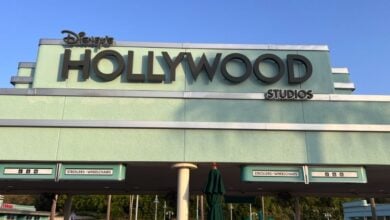
For years, Disney’s Hollywood Studios has been the most difficult Walt Disney World park to explain.
Magic Kingdom is easy. It is a celebration of fantasy, fairy tales, and classic Disney storytelling. EPCOT focuses on innovation, culture, and discovery. Disney’s Animal Kingdom combines conservation, adventure, and immersive environments.
Hollywood Studios, however, has spent nearly two decades in a constant state of evolution.
Guests have watched iconic attractions disappear, entirely new lands emerge, and the park transform from a celebration of filmmaking into something that often felt harder to define. Every few years, another major addition seemed to pull the park in a new direction.

Toy Story Land arrived. Star Wars: Galaxy’s Edge followed. Mickey & Minnie’s Runaway Railway replaced The Great Movie Ride. Soon, Monstropolis will take over the former Muppets Courtyard.
The changes have been exciting. They have also raised an important question.
What exactly is Disney’s Hollywood Studios supposed to be now?
After years of uncertainty, Disney may have finally revealed the answer.
The Original Vision Slowly Disappeared
When Disney-MGM Studios opened in 1989, the concept was crystal clear.
Guests were stepping into Hollywood.
The park celebrated the movie industry through production tours, animation exhibits, stunt shows, and attractions that showcased the filmmaking process. Visitors could watch animators work, see how special effects were created, and learn what happened behind the camera.
The park felt like a living studio.
As the years passed, however, guest expectations changed.
Visitors became less interested in learning how movies were made and more interested in experiencing the worlds they loved on screen. Disney responded by gradually shifting the park away from production-focused experiences and toward immersive storytelling.
The result was a park that became incredibly popular but increasingly difficult to categorize.
A Collection of Worlds Without a Story
The challenge was never the quality of the additions.
Galaxy’s Edge remains one of the most ambitious themed lands Disney has ever built. Toy Story Land transformed an underutilized area of the park into a family destination. Mickey & Minnie’s Runaway Railway brought Disney animation back to the center of the park.
The problem was that none of those additions seemed connected.
Hollywood Studios started feeling like several different parks combined into one.
Guests could spend the morning in a giant toy-filled backyard, travel to a distant Star Wars outpost by lunchtime, and finish the day stepping inside a cartoon with Mickey Mouse.
Unlike the other Disney parks, there never seemed to be a larger theme tying everything together.
That may finally be changing.

The Biggest Clue Is Sitting in Plain Sight
Disney's recent work on the Walt Disney Studios Courtyard offers perhaps the strongest indication yet of where the park is headed.
The area is becoming home to a new version of The Magic of Disney Animation. It draws inspiration from the actual Walt Disney Animation Studios campus in California while also embracing ideas from Once Upon a Studio (2023), Disney’s acclaimed animated short celebrating the company’s 100th anniversary.
At first glance, that may not seem significant.
But the central idea behind Once Upon a Studio changes everything.
The short imagines Disney characters coming to life inside the animation studio itself.
Suddenly, a new possibility emerges.
What if Hollywood Studios is no longer about Hollywood?
What if it is about Disney stories escaping the studio and coming to life around guests?
The Characters Already Support the Theory
Recent character interactions have started reinforcing this idea.
Guests visiting the reimagined courtyard have encountered characters in ways that feel less structured and more spontaneous. Instead of standing behind designated photo locations, characters are wandering through the area, interacting with families, and creating unscripted moments.
Children have sat with Rapunzel in the grass. Families have encountered Donald and Goofy casually exploring the courtyard. The interactions feel more organic than traditional meet-and-greets.
That distinction matters.
The characters are no longer simply appearing for entertainment.
They feel like living parts of the environment.
If Disney continues leaning into this concept, Hollywood Studios gains something it has lacked for years: a clear narrative identity.
Suddenly Every Land Fits
This is where the idea becomes fascinating.
Under the old Hollywood theme, some of the newer additions often felt disconnected from one another.
Under the new storytelling concept, everything starts making sense.
Toy Story Land becomes a world created through imagination.
Mickey & Minnie’s Runaway Railway literally places guests inside a cartoon.
Monstropolis becomes another animated world stepping into reality.
Even Galaxy’s Edge works because it represents a story brought to life through Disney’s creative magic.
Instead of asking why these lands coexist, guests can view them as examples of Disney stories becoming real.
That simple shift creates a surprisingly strong connection between areas that once felt unrelated.
The Sorcerer Hat Suddenly Has New Meaning
Perhaps no symbol better represents this evolution than the Sorcerer Hat.
When the original hat stood in front of the Chinese Theatre, it became one of the park’s most debated landmarks. Some fans loved it. Others celebrated when it was removed.
Now Disney is bringing the icon back as part of the animation-focused area.
This time, however, the symbolism feels different.
In Fantasia (1940), the Sorcerer Hat represents imagination, creativity, and magic. It is not a symbol of Hollywood filmmaking. It is a symbol of stories coming to life.
That makes it a perfect fit for the direction Disney appears to be pursuing.
Rather than serving as a reminder of the movie industry, the hat becomes a representation of Disney imagination itself.
What Monstropolis Tells Us About the Future
The upcoming Monstropolis expansion may be the clearest example yet of where Hollywood Studios is headed.
For years, fans viewed new intellectual property additions as replacements for the park’s original identity.
Monstropolis suggests Disney sees them differently.
Rather than replacing the theme, Disney appears to be redefining the theme.
The park is no longer about the process of creating entertainment.
It is about the worlds that entertainment creates.
That distinction gives Disney enormous flexibility moving forward. Virtually any Disney-owned franchise can fit into the park if the overarching story is that imagination is bringing these worlds to life.
The Park Disney Wanted All Along
Ironically, Hollywood Studios may finally be becoming what Disney always wanted it to be.
Not a museum dedicated to filmmaking.
Not a collection of unrelated franchises.
Not a park stuck between old Hollywood nostalgia and modern intellectual property.
Instead, it is becoming a place where Disney stories physically surround guests.
That identity feels more emotional, more immersive, and arguably more relevant to modern audiences than the original studio concept ever could.
After nearly two decades of transformation, Disney’s Hollywood Studios may finally have an answer to the question that has followed it for years.
The park is no longer about making movies.
It is about bringing Disney imagination to life.
And for the first time in a very long time, everything seems to fit.