

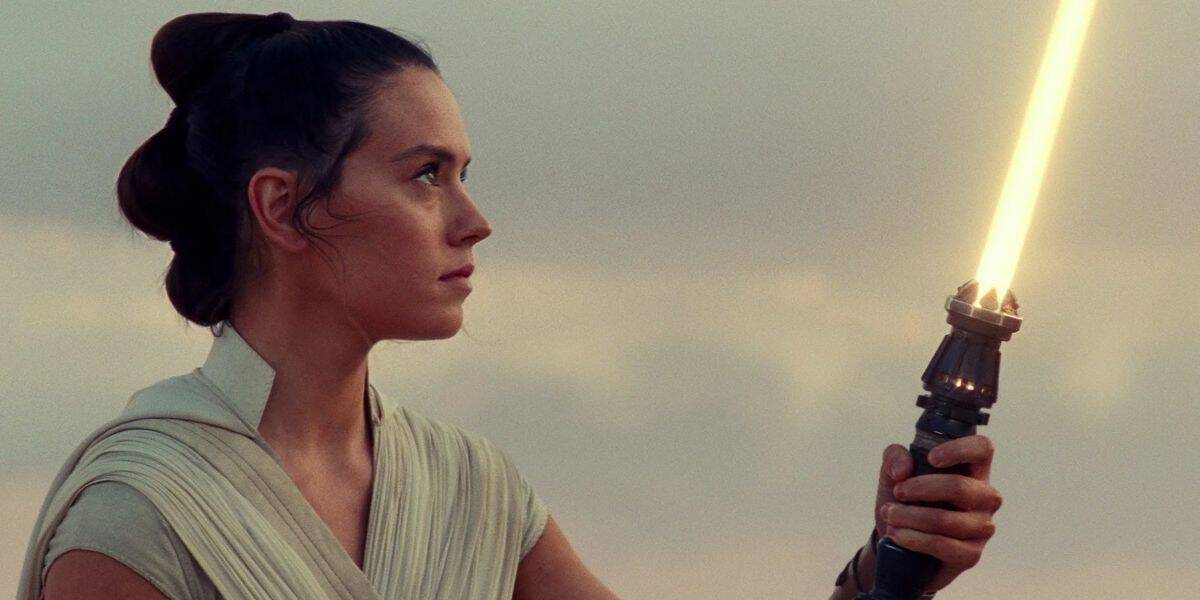
Nearly seven years after its release, Star Wars: Episode IX – The Rise of Skywalker (2019) continues to generate scrutiny over one specific narrative choice: its closing scene, in which Rey (Daisy Ridley), having defeated Palpatine (Ian McDiarmid) on Exegol, buries the lightsabers belonging to Luke and Leia Skywalker on Tatooine and identifies herself to a passerby as “Rey Skywalker.”

The moment has long been read by critics as a departure from 2017's Star Wars: Episode VIII – The Last Jedi‘s central thesis — that heroism is not contingent on lineage — with the line interpreted as a self-conferred title rather than an earned one.
In the years since, Lucasfilm has pursued a strategy of supplemental media designed to contextualize that ending. An updated edition of “The Secrets of the Jedi: The Chronicles of Luke Skywalker” incorporated a first-person passage from Rey clarifying that she adopted the Skywalker name to honor Luke's legacy and continue his work, rather than to assert a bloodline claim. Separately, a 2025 Marvel Comics adaptation from writer Jody Houser and artist Will Sliney provided visual representation for the previously audio-only “All the Jedi” sequence, depicting Force ghosts including Qui-Gon Jinn, Obi-Wan Kenobi, Ahsoka Tano, and Luke Skywalker.
The most substantial addition to this reframing effort, however, comes from Madeleine Roux's novel “Star Wars: Legacy,” positioned within the timeline between The Last Jedi and The Rise of Skywalker. Per reporting on the manuscript, the novel's final chapter depicts Rey and General Leia Organa jointly repairing the fractured Skywalker lightsaber on the planet Tython. Following the repair, Rey tells Leia the weapon “belonged to your family,” continuing: “I don't know if I could have done this without you. And this isn't just mine; it belonged to your family.” Leia's reported response — “Rey, I think you know that it still does” — closes the chapter, with the novel's final word given simply as “Belonging.”

Reassessing the Ending's Authorial Logic
Industry observers note that this exchange substantively alters the interpretive frame around Rey's Tatooine declaration in the film. Rather than functioning as an unearned, self-authored claim to legacy — the reading that drew sustained criticism at release — the moment is recast as the fulfillment of an invitation Leia had extended prior to the events depicted in the ninth installment.
The distinction matters for how the franchise addresses one of its most persistent points of criticism: not merely why Rey selected the Skywalker name, but on what authority she did so. Taken together with the earlier passage from “The Secrets of the Jedi,” the ending now carries two separate justifications sourced from the saga's two surviving mentor figures — Luke supplying rationale through shared values and sacrifice, and Leia, via ‘Legacy,” supplying explicit familial sanction.

A Structural Challenge to Jedi Doctrine
Beyond its narrative repair work, Star Wars: Legacy introduces a more consequential development: a direct challenge to one of the Jedi Order's foundational tenets as established since the prequel trilogy — that attachment, whether romantic, familial, or otherwise personal, represents a primary vector toward the dark side. That doctrine was most explicitly dramatized through Anakin Skywalker's (Hayden Christensen) concealed marriage to Padmé (Natalie Portman), and reiterated through Luke Skywalker's own struggles in later material.
Roux's novel positions Rey and Leia's study of Jedi history and texts — undertaken while repairing Luke's lightsaber — as the vehicle for Rey's growing skepticism of the Order's institutional record, including its isolated training temples, the destruction of Luke's school, and its historical practice of removing Force-sensitive children from their families.
That skepticism culminates in a direct rebuttal of the anti-attachment principle. Rey tells Leia: “Jedi were taught to let go of all attachments, but everyone needs something to fight for, and more than just ideas, people.”
The statement recasts attachment as a potential source of resilience rather than a liability requiring suppression, indicating that any Jedi Order Rey subsequently establishes is likely to diverge structurally from the more rigid, insular model depicted in the prequel era. The thematic groundwork aligns with material already present in the sequel trilogy, given Luke's own criticism of Jedi institutional failures in The Last Jedi and Rey's consistent narrative emphasis on found family over doctrinal adherence.
Development Context and Future Films
The reframing arrives amid continued uncertainty regarding the franchise's theatrical pipeline. Following a seven-year gap in Star Wars releases, The Mandalorian and Grogu opened in May 2026, with Shawn Levy's Starfighter scheduled for 2027. Three previously announced films — from James Mangold, Dave Filoni, and Sharmeen Obaid-Chinoy — remain stalled in development, while producer Simon Kinberg is attached to a separate, newly announced trilogy. Rey's role in the franchise's next phase has not been clarified.
The thematic material introduced in Legacy is considered relevant to Obaid-Chinoy's long-gestating “New Jedi Order” project, first announced at Star Wars Celebration 2023 in London. While that film has not moved forward, it has not been formally canceled, and sources suggest its concept could ultimately be absorbed into Kinberg's trilogy plans.

Parallel Anniversary Initiative
Separately, and coinciding with the approaching 50th anniversary of Star Wars: Episode IV – A New Hope in 2027, Disney and Lucasfilm confirmed a full Welsh-language dub of the original 1977 film. The initiative, announced at the National Eisteddfod, is a joint effort between Lucasfilm, Disney, the broadcaster S4C, and the Welsh Government through its Creative Wales program. Titled Star Wars: Gobaith Newydd, the dub is set to premiere on S4C and its associated platforms on Christmas Day.
The voice cast includes Matthew Rhys as Han Solo, Rhys Ifans as Obi-Wan Kenobi, and Aimee-Ffion Edwards as Princess Leia. Mark Lewis Jones voices Darth Vader, and newcomer Osian Morgan takes on the role of Luke Skywalker. Supporting cast members include Llyr Ifans (C-3PO), Nia Roberts (Aunt Beru), Richard Harrington (Grand Moff Tarkin), Owain Arthur (Red Leader), and Rhodri Meilir (Gold Leader). Ellyn Stern is directing, with Lucasfilm's Director of Distribution Operations, Michael Kohn, producing.

Taken together, the canon revisions to Rey's arc and the anniversary-driven localization initiative point to a broader Lucasfilm strategy of reinforcing engagement with the franchise's existing library at a moment when its theatrical release calendar remains in flux.
What do you think Disney will do with the next decade of Star Wars? Let us know in the comments down below!