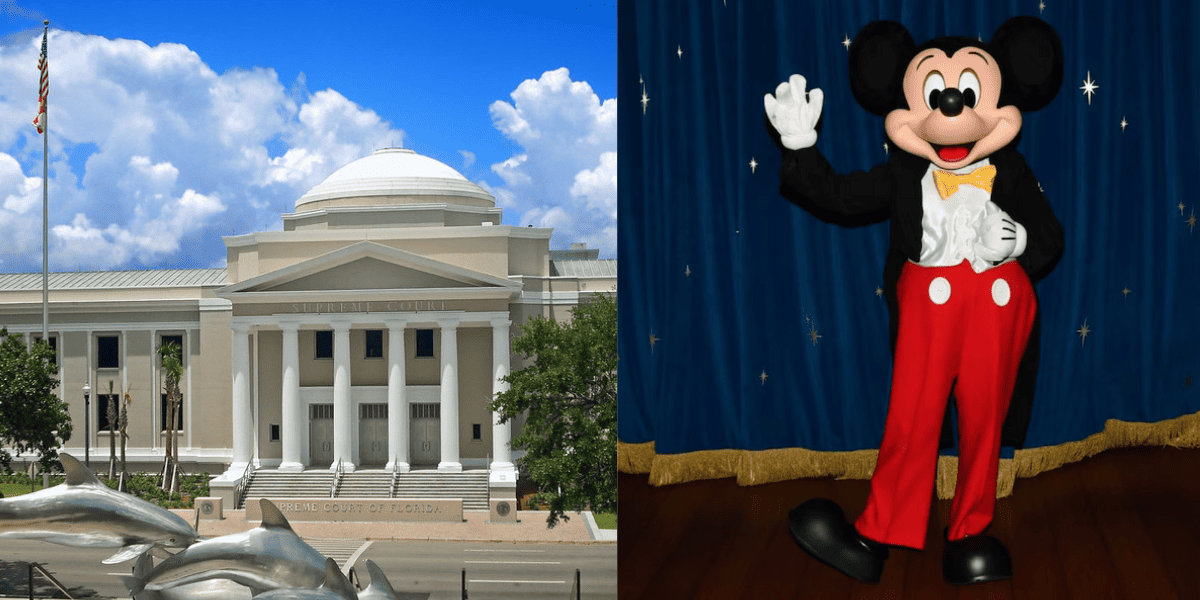
One day before Florida Governor Ron DeSantis named Meredith Sasso to the Florida State Supreme Court, her husband, Michael Sasso, quit his job. At the time, Sasso's day job was as the vice-chairman of the Central Florida Tourism Oversight District, the Board of DeSantis appointees that replaced the Reedy Creek Improvement District.

Disney currently has a case in State Court against the Central Florida Oversight District. The District claims that all deals Disney struck with the Reedy Creek Improvement District before its dissolution should be voided, while Disney is suing the Board seeking damages for breaking its contract with Reedy Creek.
And this is where the conflict of interest comes in. Should either Disney or the Board lose at the state level, they will undoubtedly appeal. The Florida State Supreme Court and Justice Meredith Sasso would eventually hear that appeal.
Not only is her husband a DeSantis ally and former vice-chairman of the Board who will present a case before her, but Michael Sasso was also the best man at Board Administrator Glen Gilzean's wedding. Sasso was also instrumental in bringing Gilzean on as the Board's Administrator, speaking highly of him during the meeting that he was nominated.

There are guidelines for when and how judges should recuse themselves in cases like this. According to the guidelines, judges should recuse if their “impartiality might reasonably be questioned,” including instances in which a judge's spouse has an interest that could be affected.
While there are guidelines, there are no steadfast rules for when a judge should step aside. It is up to each judge when to recuse themselves.
Bob Jarvis, a law professor at Nova Southeastern University, told the Orlando Sentinel:
There is no one that can police a Florida Supreme Court justice and tell them that they need to recuse themselves. What we need is such an entity.

In Disney's other case against Florida Gov Ron DeSantis in Federal Court, US District Court for the Northern District of Florida, Judge Mark E. Walker recused himself. Walker, an appointee of former President Barack Obama, said that a “relative within the third degree of relationship” owned 30 shares of Disney stock. While that may not seem like as big a deal as being married to someone who was once a part of the plaintiff in the case, Walker still recused himself. Judge Allen C. Winson, an appointee of former president Donald Trump, is now hearing the case.
The Florida Supreme Court has seven justices, five of whom were appointed by Governor DeSantis. The District has hired Alan Lawson as its lead attorney, who, at 61, retired from the Florida Supreme Court. It is virtually unheard of for a former justice to argue a case in front of the court he once served on, but it is not illegal in Florida.
Dick Batchelor, a former Democratic state representative and political analyst, says that the hiring of Lawson is a calculated strategy by the Board to influence the proceeds before they even begin.

Batchelor told the Orlando Sentinel:
It is a very well orchestrated effort to pre-influence what will ultimately be a case appealed to the Florida Supreme Court.
This puts the Walt Disney Company at a disadvantage in its Federal Lawsuit and State Lawsuit. Disney has narrowed its Federal Lawsuit to focus solely on Gov DeSantis' and government retaliation for speaking out against Florida's Parental Rights in Education Act.
Disney's lawsuit in State Court seeks damages for the CFTOD and Governor DeSantis for breaking its contract over the governing District of Walt Disney World. Just yesterday, the Board asked the state court to dismiss Disney's claim for damages.

No matter how this ends in Federal and State Courts, it will eventually end up in the Supreme Court and will take years to settle. But if none of the judges on the Florida Supreme Court recuse themselves, Disney will find its case much harder to argue.
We will continue to update this story at Disney Fanatic.