
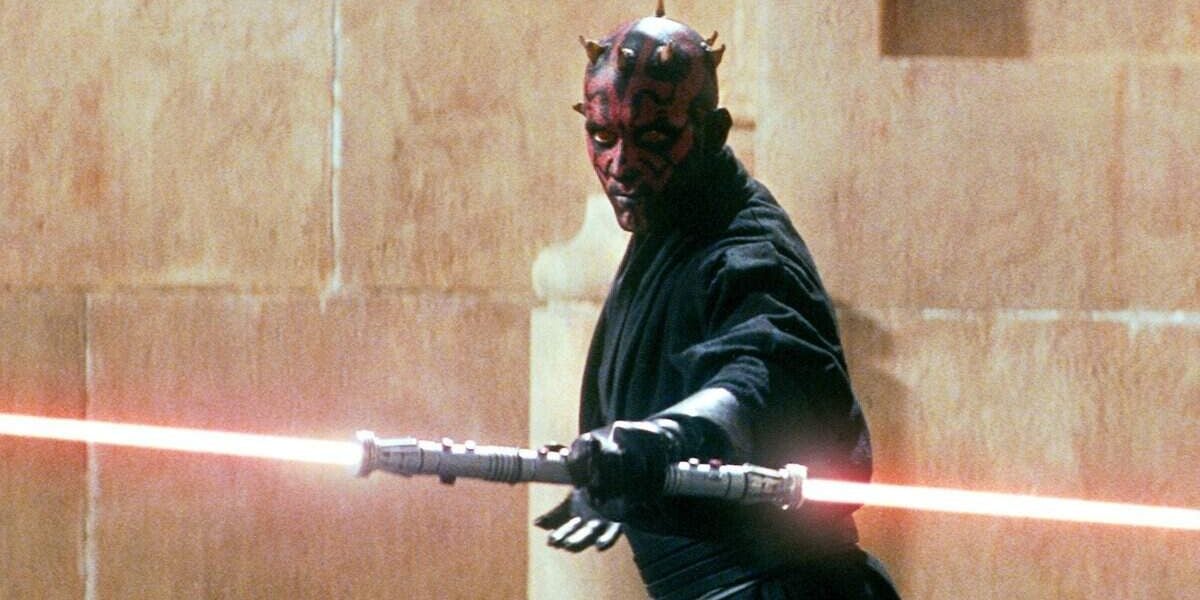
When Star Wars: Episode I – The Phantom Menace (1999) first arrived in theaters, Darth Maul immediately became one of the most talked-about parts of the movie.
Even fans who were unsure about the prequel trilogy itself usually agreed on one thing: Maul looked incredible. His red-and-black Zabrak markings, his horns, his double-bladed lightsaber, and his aggressive fighting style instantly separated him from every Sith fans had seen before.
But despite all of that popularity, there was always one major criticism surrounding the character.

He barely felt like a character at all.
Maul hardly spoke during the film. Most of his scenes involved him standing silently beside Darth Sidious or hunting Jedi across the galaxy before eventually battling Qui-Gon Jinn and Obi-Wan Kenobi. Then, almost as quickly as he appeared, he was defeated.
For years, many fans viewed Darth Maul as one of Star Wars’ biggest missed opportunities.
Now, nearly three decades later, Disney and Lucasfilm have completely changed that perception.
Darth Maul Became More Than a Silent Villain
When audiences first met Maul in 1999, he mostly existed as a physical threat. He looked dangerous, fought dangerously, and carried an intimidating presence, but viewers knew almost nothing about his personality, motivations, or emotional state.
That slowly began to change once Star Wars: The Clone Wars (2008) brought him back.
At first, the idea sounded risky. Reviving a villain who had been cut in half during The Phantom Menace could have easily felt ridiculous. Instead, Lucasfilm used the opportunity to completely rebuild the character from the ground up.
The animated series transformed Maul into something far more tragic.
Instead of simply portraying him as evil, The Clone Wars explored his anger, abandonment, obsession, and emotional instability. His hatred toward Obi-Wan Kenobi suddenly carried emotional weight because audiences finally understood how broken Maul had become after losing everything.
For the first time, fans started seeing Maul as someone shaped and manipulated by the Sith rather than just another generic dark side warrior.
Disney Expanded the Character Even Further
After Disney acquired Lucasfilm, many fans expected the company to focus primarily on new characters and future timelines.
Instead, Disney-era Star Wars kept revisiting the prequels and adding layers to characters that originally lacked depth.
Star Wars Rebels (2014) pushed Maul’s story into even darker territory. By that point, he no longer felt like an unstoppable Sith assassin. He felt exhausted, bitter, isolated, and emotionally destroyed by years of failure and obsession.
That version of Maul became fascinating because he was no longer chasing power alone. He was chasing purpose.
More recent Disney+ storytelling, especially Maul – Shadow Lord, has taken things even further by diving into Maul’s trauma and the psychological damage caused by Darth Sidious.
Modern Star Wars canon now frames Maul less as a straightforward villain and more as a victim of Sith conditioning. He was raised to become a weapon from childhood, stripped of any normal life, and consumed by rage long before audiences ever met him in The Phantom Menace.
That changes the way fans watch the movie today.
The Phantom Menace Feels Completely Different Now
What makes this evolution so impressive is that Disney never actually changed the original film itself.
The scenes are all still there exactly as audiences remember them. Maul still speaks very little. The duel still ends the same way. The story itself remains untouched.
But the emotional context surrounding the character is completely different now.
Back in 1999, Maul represented danger and mystery. Today, he represents tragedy.
Modern viewers already know where his story leads. They understand the pain, paranoia, and emotional collapse waiting ahead for him. That retroactively gives his scenes in The Phantom Menace far more emotional depth than they originally had.
In many ways, Disney and Lucasfilm quietly retconned how fans emotionally process the prequel trilogy without actually rewriting the films themselves.
That is not something many franchises successfully pull off.
Disney Quietly Improved the Entire Prequel Era
Darth Maul is not the only prequel-era villain who benefited from expanded storytelling.
Characters like Count Dooku, Barriss Offee, and even smaller political figures like Nute Gunray and Mas Amedda have all gained additional depth through animated shows, comics, novels, and Disney+ projects.
For years, one of the biggest criticisms surrounding the prequels was that many villains felt underdeveloped compared to Darth Vader or Emperor Palpatine.
Now, the era feels much richer and more interconnected.
The Jedi Order feels more flawed. The Republic feels more unstable. The villains feel more human and emotionally damaged instead of simply evil for the sake of evil.
That extra storytelling has helped improve how many fans view the prequel trilogy overall.
Darth Maul May Be One of Star Wars’ Best Villains Now
That idea would have sounded ridiculous back in 1999.
At the time, Maul was mostly remembered for an awesome lightsaber fight and a striking design. Few people would have ranked him among the franchise’s greatest villains from a storytelling perspective.
Today, that conversation has completely changed.
Many fans now place Maul alongside Darth Vader and Emperor Palpatine because of how emotionally layered he became over time. His rage feels personal. His obsession feels believable. His downfall feels tragic.
Ironically, making Maul more vulnerable made him far more compelling.
And after nearly 30 years, Disney+ storytelling has completely changed how audiences revisit The Phantom Menace.
The movie itself did not change.
But Darth Maul absolutely did.