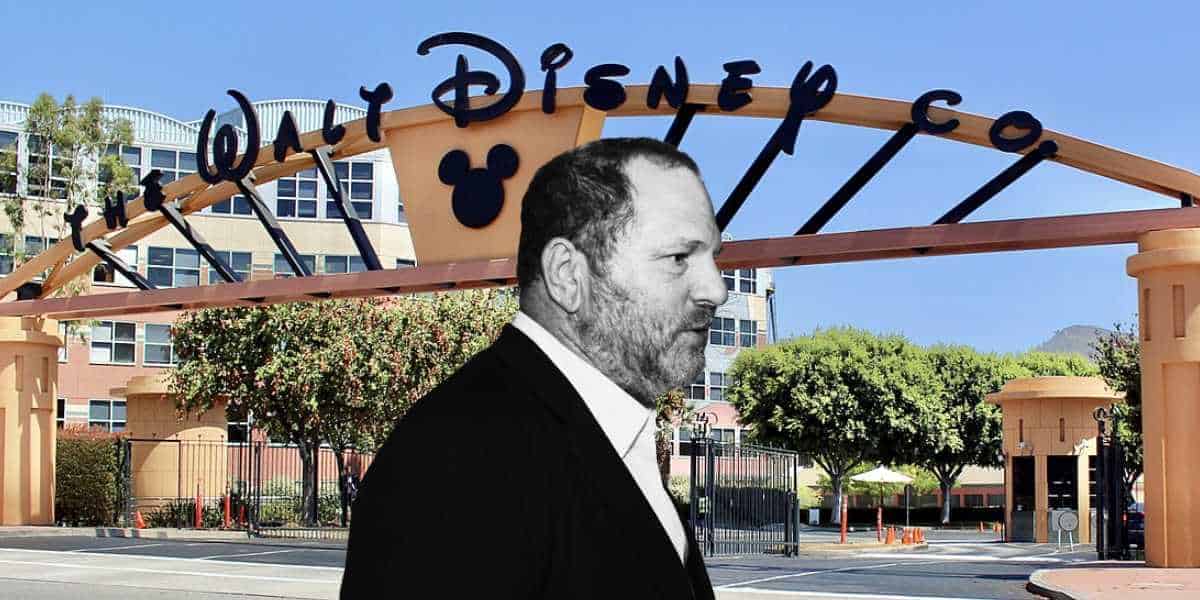
In the world of corporate branding, The Walt Disney Company is the undisputed gold standard of “family-friendly” entertainment. But as the “House of Mouse” navigates the complexities of the mid-2020s, an uncomfortable ghost from its past has resurfaced. Despite being a convicted sex offender serving a combined 39-year sentence, Harvey Weinstein is still allegedly receiving a monthly pension check from Disney.

To the public, it sounds like a plot twist from a dark satire: How can a company that prides itself on virtue continue to provide a financial safety net for one of history’s most notorious predators? The answer is a toxic cocktail of 1990s acquisition deals, federal labor laws, and a contract that was designed to be “divorce-proof.”
The 1993 Acquisition: When Disney Bought Miramax
The connection began in 1993, when Disney made the seismic decision to purchase Miramax, the independent film studio founded by Harvey and Bob Weinstein. At the time, the $60 million deal was hailed as a masterstroke. Disney gained “prestige” and a pipeline to the Academy Awards, while the Weinsteins gained the infinite resources of a global conglomerate.

Crucially, the deal transformed the Weinstein brothers into high-level Disney executives. For the next 12 years—the period during which Harvey’s predatory behavior was allegedly at its peak—he was technically on the Disney payroll. During this decade-plus tenure, Weinstein was enrolled in the executive retirement and pension programs afforded to all Disney VPs. By the time he and Bob split from Disney in 2005 to form The Weinstein Company, his pension was fully vested.
The ERISA Shield: Why Disney Can’t Stop the Checks
When the #MeToo movement brought Weinstein’s crimes to light in 2017, Disney CEO Bob Iger was swift to condemn him. However, “condemning” a person and “confiscating” their pension are two very different legal battles.
The primary obstacle for Disney is ERISA (the Employee Retirement Income Security Act of 1974). This federal law was enacted to protect American workers' retirement assets from seizure by their employers. One of its most rigid pillars is the non-forfeiture provision, which states that once a pension is earned and vested, it is considered the legal property of the employee.
Because Weinstein was a Disney employee for over a decade, that money is legally his. Federal law generally does not allow a corporation to cancel a pension as a punishment for criminal behavior unless that specific provision was written into the contract in accordance with strict federal guidelines—a rarity in the early '90s. If Disney were to stop the checks, Weinstein’s legal team could sue under federal labor law, a battle Disney would likely lose.
The Jailhouse Taunt: $15,000 a Month from a Prison Cell?
In a recent jailhouse interview, Weinstein reportedly made a pointed reference to his financial “security,” implying that his “old friends at Disney” were still providing for him. While likely intended to aggravate his detractors, the comment highlights a grim reality. Estimates from industry insiders suggest that Weinstein’s monthly Disney pension ranges from $10,000 to $15,000.

For a man whose once-vast fortune has been decimated by legal fees and massive civil settlements, these monthly payments represent a stable stream of income that prison walls cannot block. While Disney has scrubbed his name from credits and distanced itself from the Miramax era, the legal obligation to cut that check remains a recurring PR nightmare.
A Small Measure of Justice
There is, however, a silver lining for the survivors of Weinstein's abuse. While Disney is legally required to pay the pension, the money doesn't always remain under Weinstein's control.
Due to the mountain of civil judgments against him, many of his assets—including his pensions and residuals—are subject to liens and garnishments. In many cases, these checks are diverted to pay off settlements or the massive debts he owes to his victims. In this way, Disney is effectively paying for Weinstein’s restitution, though the optics of “Disney paying Weinstein” remain a bitter pill for the public to swallow.
Conclusion: A Cautionary Tale for the Corporate World
The case of Harvey Weinstein’s Disney pension serves as a stark reminder of the long tail of corporate contracts. It proves that the “prestige” hires of today can become tomorrow's liabilities, and the legal structures built to protect employees can inadvertently protect monsters.

As Weinstein remains behind bars, the Disney pension stands as the final, unwanted link in a 30-year marriage. It is a monthly reminder that while a company can change its CEO, its brand, and its values, it cannot easily escape the federal laws that protect a vested contract—no matter how “abhorrent” the recipient may be.
Are you surprised that a company as powerful as Disney can't legally stop these payments? Should federal laws be changed to allow for “morality-based” pension forfeiture? Let us know in the comments below.