For years, The Lost Continent stood as something different.
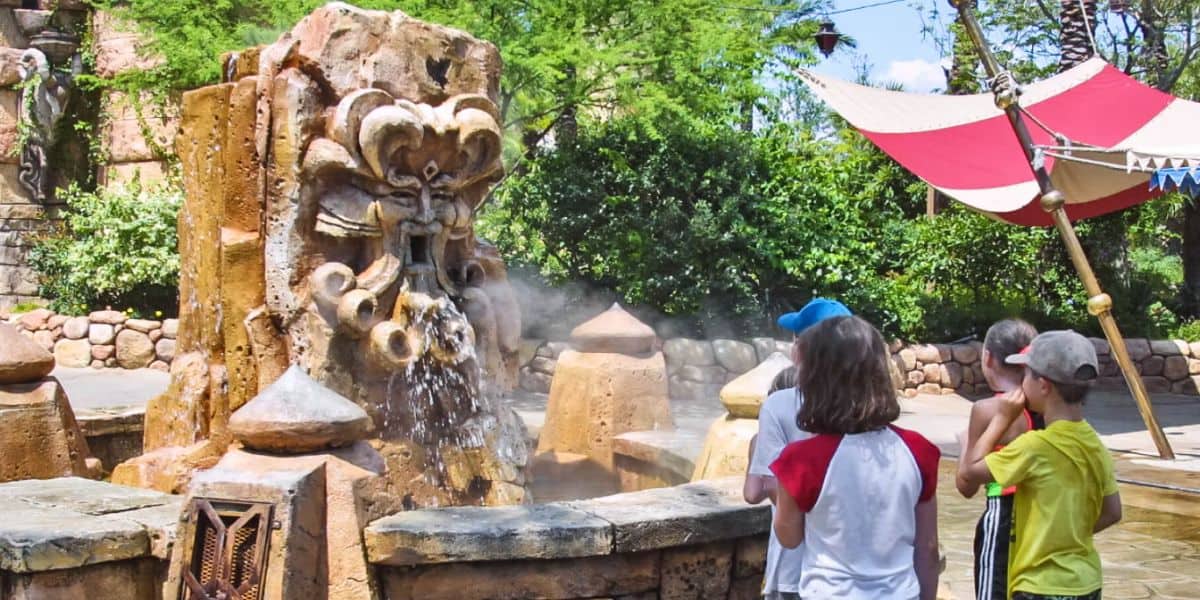
It wasn't based on a blockbuster movie. It didn't rely on recognizable characters. There were no wands, superheroes, or animated mascots waiting around every corner. Instead, guests wandered through weathered stone pathways, ancient ruins, towering statues, and a world that felt pulled from mythology itself.
And now, another piece of that world is gone.
As demolition work continues throughout Universal Orlando Resort's Islands of Adventure, reports have confirmed that two of The Lost Continent's most recognizable landmarks have officially disappeared: Poseidon's Trident and the beloved Sinbad archway. For longtime visitors, these weren't just decorative elements. They were visual anchors that helped define one of the park's original lands dating back to 1999.
Their removal marks yet another emotional milestone in what has become the slow unraveling of one of Universal's most nostalgic themed environments.
Fans Are Watching Their Childhood Memories Disappear
For many guests, The Lost Continent represented something increasingly rare in modern theme parks: original storytelling.
The trident has fallen! The iconic statue that greeted guests when entering Poseidon’s Fury and the Lost Continent has been demolished. RIP. – @insideuniversal on X
The trident has fallen! 🔱
The iconic statue that greeted guests when entering Poseidon’s Fury and the Lost Continent has been demolished.
RIP. @UniversalORL pic.twitter.com/lHjwSsBsJF
— Inside Universal (@insideuniversal) June 16, 2026
Before intellectual property became the dominant force behind major theme park expansions, lands like The Lost Continent invited guests into entirely new worlds built from imagination, mythology, and adventure. Walking beneath the Sinbad archway or spotting Poseidon's massive trident immediately transported visitors into a realm inspired by ancient legends.
That sense of immersion became a defining part of Islands of Adventure's identity when the park first opened.
Now, with both landmarks reportedly removed, fans across social media have been sharing photos, memories, and reflections on what the land once meant to them.
For some, it's less about the structures themselves and more about what they represented. Every demolished arch, statue, or facade serves as another reminder that the Islands of Adventure many guests grew up with is rapidly evolving into something very different.

What Started as Small Changes Has Become Something Much Bigger
The transformation of The Lost Continent hasn't happened overnight.
The Sindbad Archway has also been demolished.
The Sindbad Archway has also been demolished. @UniversalORL pic.twitter.com/jnMEW4lPZ2
— Inside Universal (@insideuniversal) June 16, 2026
Over the years, portions of the land have gradually shifted. The most significant change came when much of the original area was absorbed into The Wizarding World of Harry Potter – Hogsmeade, dramatically reshaping the footprint and purpose of the land.
Even after those changes, however, portions of The Lost Continent remained standing as a reminder of the park's original vision.
Recent demolition activity suggests that chapter may finally be closing.
The removal of highly visible landmarks like Poseidon's Trident and the Sinbad archway signals something larger than routine refurbishment. While Universal has not publicly announced what the future holds for the area, the scale of the work has only intensified speculation among theme park fans.
And that's where things get particularly interesting.

The Internet Has No Shortage of Theories
With Universal remaining silent about the future of the space, fan communities have eagerly filled the information vacuum.
Among the most frequently discussed possibilities is Pokémon, a franchise that many fans believe would fit naturally within Universal's growing portfolio of immersive experiences. The global popularity of Pokémon, combined with Universal's history of leveraging major entertainment brands, makes it one of the more frequently cited predictions.
Another fan-favorite possibility is The Legend of Zelda.
The fantasy-driven world of Hyrule seems tailor-made for a richly themed environment filled with exploration, mythology, and adventure—qualities that once defined The Lost Continent itself. For many fans, Zelda feels like a spiritual successor capable of preserving some of the land's original sense of wonder while introducing a globally recognized franchise.
Other names continue to circulate online as well, including One Piece and Wicked.
At this stage, however, all of these remain purely speculative. Universal has confirmed nothing, and there is currently no official indication regarding what may ultimately occupy the space.
One Possibility Continues to Capture Fans' Imaginations
Among the countless theories, one stands out for a very specific reason.
The Lord of the Rings.
While there is currently no evidence suggesting Universal is actively pursuing Middle-earth for this location, the idea continues to resonate because of how naturally it aligns with the atmosphere that once defined The Lost Continent.
Ancient architecture. Mythology. Epic adventure. Legendary heroes. Timeless storytelling.
Many of the qualities that made guests fall in love with The Lost Continent decades ago are the same qualities that have kept Tolkien's world beloved for generations.
Whether realistic or not, the popularity of the theory reveals something important about the current conversation. Fans aren't simply looking for the next big intellectual property. Many are hoping Universal preserves the sense of discovery and wonder that made this corner of Islands of Adventure special in the first place.

The Future May Be Exciting—But Something Is Still Being Lost
Theme parks evolve. They always have.
New attractions arrive, guest expectations change, and entertainment companies constantly look for ways to remain competitive. Universal's recent growth, including the opening of major expansions and entirely new destinations, demonstrates just how aggressively the company is investing in the future.
Yet moments like this remind fans that progress often comes with a price.
The removal of Poseidon's Trident and the Sinbad archway may seem like small developments in the grand scheme of Universal Orlando's future plans. But for countless guests who walked beneath those structures over the past quarter-century, they represented a different era of theme park design—one built on original ideas, mysterious worlds, and the thrill of stepping into the unknown.
As demolition continues and speculation grows louder, one thing is becoming increasingly clear: whatever eventually rises from the remains of The Lost Continent will inherit more than valuable real estate. It will inherit the expectations, memories, and emotions of an entire generation of Universal fans still hoping that the next chapter feels just as magical as the last.